We don't guess at AI opportunities. We measure them.
Most AI consulting firms start with workshops and interviews. SkyView Labs starts with data. Our discovery methodology deploys lightweight behavioral telemetry agents across your workforce for 14 days, then runs an AI analysis pipeline over the results to produce prioritized, evidence-backed automation and AI opportunities — with specific estimates attached to each one.
How it works
SkyView deploys a signed, lightweight Windows agent (MSI installer, local admin, 5 minutes to deploy) to each participating machine. The agent runs as a background service — imperceptible to users, consuming less than 0.5% CPU and under 25MB of RAM. It captures behavioral signals only: which applications are in use, how often people switch between them, what file types they're handling, and where they spend their time.
Every 15 minutes, the agent batches and uploads its buffer — compressed, encrypted, HMAC-signed — to the ingest endpoint. After 14 days (or earlier if the engagement scope is met), the agent automatically stops capture and self-uninstalls. No manual removal step. No residual software.
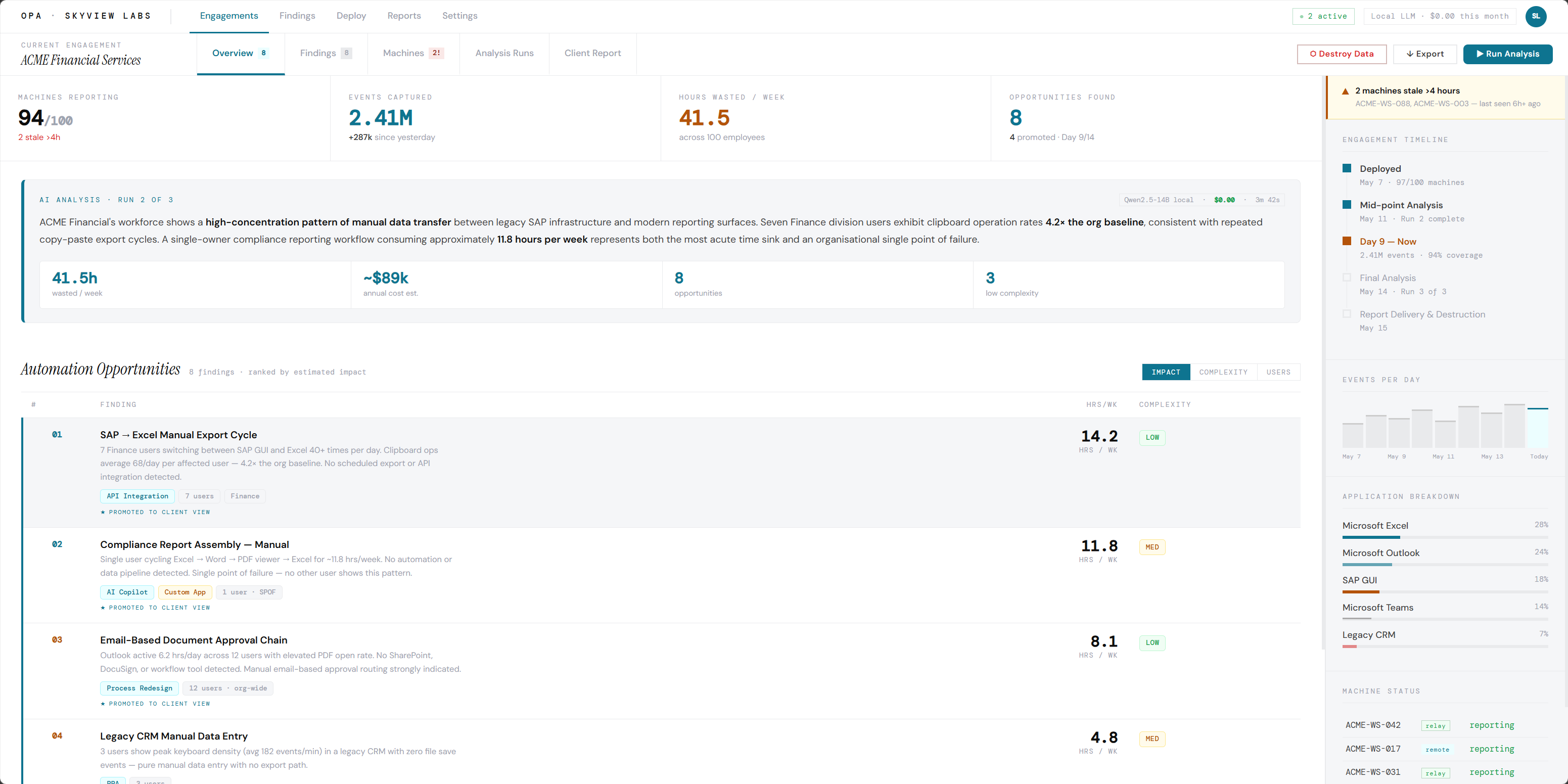
At the end of the capture period, our AI analysis pipeline processes the aggregated behavioral profiles and produces a structured findings report: ranked opportunities, the telemetry evidence behind each one, estimated hours wasted per week, and a recommended approach — whether that's an RPA automation, a custom AI application, a system integration, or a process redesign. Each finding maps directly to a SkyView service.
// opa.skyviewlabs.com — consultant dashboard
What we capture — and what we never touch
- Foreground application name and window title (sanitized — see below)
- Application transition events — what users switch from and to, and how long before switching back
- Browser domain only (e.g., salesforce.com) — no full URLs, no page content
- File operations by type: open, save, print — extension and operation only, never filename or content
- Keyboard and mouse activity rate (events per minute — not keystrokes, not content)
- Meeting presence — camera/mic active flag only, no audio or video
- Idle and lock-screen events
- Keystroke content — what you type is never recorded
- Clipboard content — copy/paste data is never captured
- Screenshots or screen recordings
- File content — documents, spreadsheets, emails remain untouched
- Email or chat message body
- Passwords or form field content
- Network traffic or packet data
- Audio or video
Your data stays where you need it
Three deployment modes. Every engagement uses whichever fits your compliance posture. The capture agents are identical across all three — only the ingest endpoint changes.
SkyView private server
Telemetry is uploaded encrypted and HMAC-signed to our self-hosted server — not a cloud provider, not a SaaS vendor. No third party ever receives your data. The analysis runs on a locally-hosted AI model. No telemetry ever leaves to an external AI API.
- Data at
- SkyView private cloud
- AI model
- Self-hosted — no API calls
- Right for
- Most mid-market engagements
Stays in your network
A compliance node runs entirely inside your perimeter on a server you control. Raw telemetry never leaves your network. The AI analysis runs on-premises. SkyView receives only the final findings JSON (~50KB) — or nothing at all in fully air-gapped mode.
- Raw data at
- Your network, your hardware
- AI model
- On-prem, CPU-only, no GPU required
- Right for
- Healthcare · finance · legal · federal
Nothing leaves at all
In fully air-gapped mode, the compliance node is completely isolated. SkyView VPNs in (or visits on-site) to view findings and export the report. Zero data is transmitted upstream at any point. At engagement end, the Docker stack is torn down and all data destroyed on-premises.
- Data transmitted
- Zero — nothing upstream
- Access
- SkyView VPN or on-site visit
- Right for
- ITAR · air-gap mandates · sovereign
What you get at the end
The output is a ranked findings report — not a slide deck of generic AI suggestions, but specific opportunities backed by telemetry evidence with estimates attached.
Each finding includes:
- The specific behavioral pattern observed in the data
- Which users (anonymized) are affected and how often
- Estimated hours wasted per week — conservative, data-backed
- Solution category: RPA, API integration, AI copilot, custom app, or process redesign
- Recommended build approach
- How a SkyView engagement would scope and deliver it
The report rolls up to an executive summary with a total estimated hours-saved figure. Findings are ranked by a composite of impact, affected-user count, and implementation complexity. You leave with a prioritized action list — not a to-do for a future strategy conversation.
How discovery leads to a build
The Discovery engagement is flat-fee — typically $10,000–$25,000 depending on workforce size and organizational complexity. The fee is fully credited against any SkyView build engagement that starts within 90 days.
At the end of 14 days, SkyView presents the findings to your leadership team. We walk through the ranked opportunities, answer questions about methodology and evidence, and give you an honest read on which opportunities are worth building first and what each would cost. If we're the right firm for the work, we scope it. If we're not, the report is yours to act on independently — the deliverable is written that way.
Most clients end up with a shortlist of two or three builds. We scope the highest-priority one in detail and begin development. The rest go into a roadmap. The data from the discovery period continues to be useful for months.
Data-Driven Discovery — frequently asked questions
The questions we get most often, answered. If yours isn't here, ask it on a 30-minute call — we answer the awkward ones too.
Will employees know they're being monitored?
What happens to the data after the engagement ends?
Can you deploy this in a Citrix or virtual desktop environment?
Can the agent be blocked by our antivirus or EDR?
What if some employees work remotely and some are in office?
Do you use AI to analyze the telemetry — and where does that AI run?
How is this different from just doing stakeholder interviews?
Start with data, not assumptions.
A 14-day discovery engagement tells you exactly where AI will move your numbers — and where it won't. Flat fee, credited against any build.